GEO vs. SEO: The New Term Every Business Owner Needs to Understand in 2026
Search Is Changing Faster Than Most Businesses Realize
In 2026, the way customers find businesses online is changing faster than ever. Traditional search engine optimization (SEO) is still important, but a new strategy is starting to dominate digital marketing conversations: GEO.
If you’ve recently noticed that customers are getting answers directly from AI tools like ChatGPT, Google AI Overviews, Gemini, or Perplexity instead of clicking through websites, you’re already seeing the shift happen in real time.
Many business owners are asking the same question:
“Is SEO still enough?”
The short answer is no.
Today, businesses need to understand the difference between GEO vs. SEO and how both strategies work together to keep their brand visible online. Companies that adapt early will have a major advantage, while businesses relying only on traditional SEO may slowly lose visibility as AI-generated search results become more common.
In this guide, we’ll break down what GEO means, how it differs from SEO, and what your business should be doing right now to stay ahead in 2026.
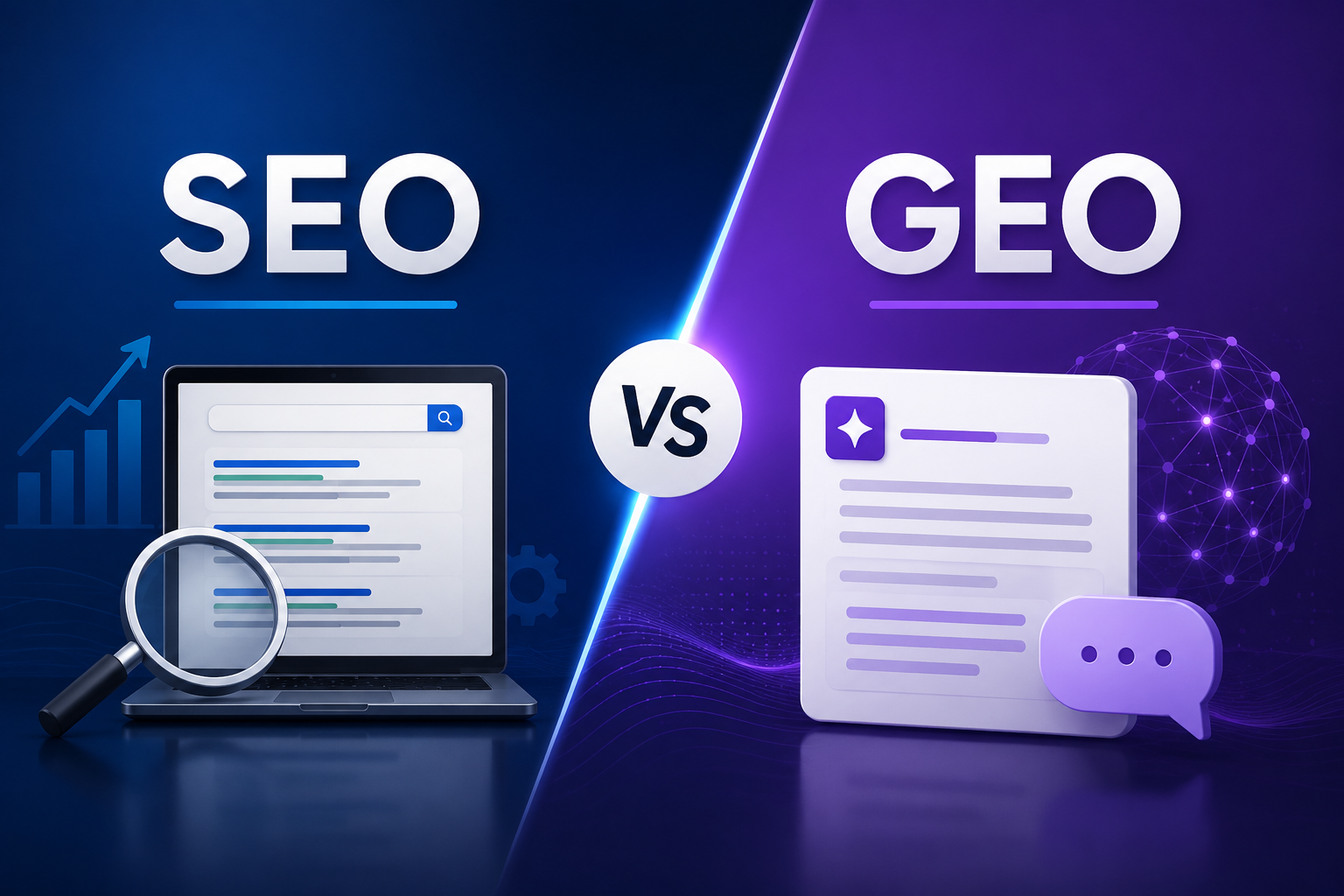
What Is GEO vs. SEO?
SEO stands for Search Engine Optimization. It’s the process of improving your website so it ranks higher on search engines like Google and Bing.
GEO stands for Generative Engine Optimization. It focuses on optimizing your content so AI-powered search tools and generative engines can understand, trust, and reference your business in their answers.
Traditional SEO helps your website appear in search results.
GEO helps your business appear inside AI-generated responses.
That difference is huge.
For years, businesses focused on keywords, backlinks, and rankings. While those still matter, AI-driven search experiences are changing how users interact with information online. Instead of scrolling through pages of results, users are now asking AI tools direct questions and receiving summarized answers instantly.
That means your business no longer competes only for rankings. You’re now competing to become the source AI chooses to reference.
Why GEO Matters More Than Ever in 2026
Consumer behavior is evolving quickly.
People no longer search the same way they did even two years ago. Instead of typing short keywords like “best roofing company near me,” users are asking conversational questions such as:
- “Who’s the best roofing company for storm damage in Dallas?”
- “What marketing agency specializes in AI SEO strategies?”
- “Which local business has the best reviews and fastest response times?”
AI engines are designed to provide direct, trusted answers to these questions. If your content isn’t optimized for this environment, your visibility can decrease — even if your website ranks well traditionally.
Businesses that ignore GEO risk:
- Losing organic traffic over time
- Becoming less visible in AI summaries
- Falling behind competitors in adapting to AI search
- Missing high-intent customers earlier in the buying process
The businesses winning online in 2026 are building strategies around both SEO and GEO instead of treating them as separate systems.
The Biggest Difference Between GEO and SEO
The easiest way to understand GEO vs. SEO is to think about how information is delivered.
SEO Focuses on Rankings
Traditional SEO aims to:
- Rank pages on search engines
- Increase clicks to your website
- Optimize keywords and metadata
- Build backlinks and authority
Success is measured through:
- Rankings
- Website traffic
- Click-through rates
GEO Focuses on AI Visibility
GEO aims to:
- Make content understandable for AI models
- Improve authority signals and trustworthiness
- Structure information clearly for AI summarization
- Increase the chances of being cited or referenced in AI-generated answers
Success is measured through:
- AI mentions and citations
- Brand visibility inside AI platforms
- Topical authority
- Trust and contextual relevance
This doesn’t mean SEO is dead. It means SEO is evolving.
Businesses now need content that works for both human readers and AI systems.
How Businesses Can Adapt to GEO in 2026
The good news is that businesses don’t need to completely rebuild their marketing strategy. Most companies already have the foundation — they just need to adapt their content approach.
Here are some of the most important steps businesses should take.
Create Helpful, Authoritative Content
AI tools prioritize trustworthy, useful content.
Thin blog posts stuffed with keywords no longer perform well. Instead, businesses need:
- In-depth articles
- Real expertise
- Clear explanations
- Helpful answers to customer questions
Content should feel natural, informative, and conversational.
For example, instead of writing a generic page targeting “digital marketing services,” a stronger GEO-focused strategy would include:
- Case studies
- Industry insights
- Frequently asked questions
- Step-by-step guides
- Local expertise
- Unique perspectives
The more helpful and credible your content appears, the more likely AI systems are to use it as a reference.
Structure Content Clearly for AI Understanding
AI tools scan and summarize information differently than traditional search crawlers.
To improve GEO performance:
- Use clear H2 and H3 headings
- Break up long paragraphs
- Answer questions directly
- Use bullet points where helpful
- Include concise explanations
- Add FAQ sections when appropriate
Clear structure helps both users and AI systems process your content efficiently.
Build Brand Authority Across the Internet
AI engines look beyond your website.
They analyze:
- Reviews
- Mentions
- Citations
- Social proof
- Consistency across platforms
That means businesses need strong digital credibility.
Practical ways to improve authority include:
- Earning positive customer reviews
- Publishing consistent content
- Being featured on trusted websites
- Keeping business information updated everywhere online
- Building a recognizable brand presence
Authority matters more than ever in GEO-driven search environments.
Optimize for Conversational Search
Modern users ask questions naturally, and AI tools are built around conversational interactions.
Businesses should create content around real customer questions like:
- “How much does digital marketing cost for small businesses?”
- “What’s the difference between SEO and GEO?”
- “How do AI search engines choose recommendations?”
This approach improves visibility across both traditional search and AI-driven search experiences.
When It’s Time to Work With a Digital Marketing Professional
Many business owners assume they can simply add a few AI keywords to their website and stay competitive. Unfortunately, it’s not that simple.
The shift from SEO-only strategies to SEO + GEO requires:
- Technical optimization
- Content strategy
- AI search understanding
- Authority building
- Ongoing monitoring and adaptation
Waiting too long to adapt can hurt long-term visibility, especially as AI-generated search results continue replacing traditional clicks.
If your website traffic has declined, your leads have slowed down, or your business isn’t showing up consistently online anymore, it may be time to work with professionals who understand modern AI-driven search marketing.
At AmplifyAI, we help businesses stay ahead by combining proven SEO strategies with cutting-edge GEO optimization techniques designed for the future of search.
The Future of Search Is Already Here
The conversation around GEO vs. SEO isn’t about replacing traditional optimization. It’s about understanding how search behavior is evolving and positioning your business to stay visible in an AI-first world.
SEO still matters.
But GEO is becoming essential.
Businesses that adapt now will build stronger visibility, better authority, and more sustainable online growth moving forward.
If your company wants to stay competitive in 2026 and beyond, now is the time to modernize your digital strategy.
Call us today at 866-916-6137
